“Jai
Ma Kali”
Jai Jai Maa - Shakti Day
Play video - Belur Math to Dakshineshwar - courtesy Atma Jyoti Ashram
Read
the Blog - My Experiments with Spirituality
Click above
KALI
MA – A GLOBAL PERSPECTIVE
KALI SHAKTI

When the Gods lay
exhausted after warring with the demons, the evil-natured demon king
Mahishasura took the opportunity to assemble an army and declare himself Lord
of Heaven, Ruler of the Universe.
This blasphemy reached Vishnu's ears and, in anger, he shot forth a terrible
light from his forehead. Shiva, too, was angry. ascended from his lofty state
of meditation and beamed a sharp ray of blinding light in the same direction as
Vishnu. Brahma, Indra and the other mighty Gods did likewise, each issuing
forth piercing rays of light. All the Gods' rays joined at one point and,
slowly, the blazing concentration of light took shape in the form of a woman.
The light of Shiva formed her face; Yama gave her hair and Vishnu her arms.
From the light of Chandra, the moon God, her two breasts were formed. Indra
modeled her waist and Varuna her thighs. Earth gave her hips and Brahma gave
her feet. The light from the fire God, Agni, fashioned her three eyes. Thus,
all gods contributed their power to manifest the auspicious Devi, the great
Mother Goddess ("Devi" is derived from the Sanskrit root word
"div" which means "to shine" - the Shining One).
As soon as the Devi was fully formed, the Immortals prayed to her and worshiped
her with praise, ornaments and weapons. Shiva gave her a trident drawn forth
from his own, Vishnu a powerful discus, and Indra, the king of the Gods, gave
her a thunderbolt identical to his own. Surya, the sun God, bestowed his rays
on all the pores of her skin, and Varuna, God of the ocean, gave her a divine
crest jewel, earrings, bracelets and a garland of unfading lotuses.
"Victory to the Mother," shouted the Gods as they watched the demon
battalions approach with the beating of drums, battle cries, and the blowing of
conches. Since the
Devi was of enormous size and highly visible, the demons marched straight
toward her, attacking from all sides with arrows, clubs, swords, and spears.
Unperturbed, the Devi roared loudly and laughed a frightening, defiant laugh.
Again. And again. And then her ten arms rotated, alternately smashing weapons
of the demons and hurling them back at her attackers. With great ease, she
picked up dozens of demons at once, killing them with her sword. Some demons
she didn't even bother to pick up. She stupefied them with the tremendous noise
of her bell and then crushed them with her mace.
The demon Raktabija gave the fierce Mother Goddess a fair amount of troubles.
He possessed a special magical power which allowed him to create new demons
from his own blood. Whenever the Goddess wounded him, each drop of blood that
spilled to the ground sprouted another demon full of strength and brutality.
But in the end the Mother outwitted him. She picked up Raktabija and lifted him
high into the air to avoid spilling his blood on the ground, and then, gnashing
him between her teeth, she drank his blood and swallowed him whole.
Other demons, too, tried to confuse the Goddess with their magical powers.
Whenever they were threatened by the Devi, they changed their form and color.
But, who can escape the great Mother? Bound by her noose and spitting blood,
these demons were soon caught by the Devi. And like a child pulling a toy
train, she dragged them over the battlefield where scores of demons already lay
split into two by the sharp slashes of her sword.
Snatching some elephants with one hand, the Devi flung them into her mouth and,
together with the demon drivers, she furiously ground them up with her teeth.
She seized one demon by the hair and another by the neck. One she crushed by
the weight of her foot and another she crushed with her body.
The Mother's terrible presence filled even the sky. Black clouds gathered and
terrifying lightning lit up the ghastly shapes on the ground. There were demons
without arms, without legs, and demons torn asunder in the middle of their
trunks.
When Mahishasura, the king of the demons, saw his army devastated by the blows
of the terrible Mother Goddess, his fury knew no bounds. He expanded his body
to take on the fierce shape of a giant buffalo. Intoxicated with his own
strength and valor, he roared and charged toward the Devi.
"Roar, roar, O fool," shouted the Goddess. "Roar for a moment.
When you are slain by me, the gods will soon roar in this very place."
The earth began to tremble under the stomping feet of the Goddess. Mahishasura
fought with all his might but could not conquer the Devi. So he appealed to her
sense of justice, complaining that she fought in an unfair way. The Devi, he
claimed, received help from so many fierce Goddesses - Durga, Kali, Chamunda,
Ambika, and others - and he, Mahishasura, had to fight all by himself.
"I am all alone in the world here," thundered the Devi. "Who
else is there besides me? See, O vile one, these Goddesses are but my different
powers which again enter into my own self. I stand alone. Don't back off;
defend yourself."
The savage fight continued, and the great demon attacked the Mother Goddess
with showers of arrows. He hurled discuses, swinging his clubs and mace. To no
avail. The Devi killed him with her spear, releasing the soul from its
evil-natured body and mind.
Dust clouds carried the stench of singed skin and rotting flesh to the
blood-red horizon. The demons had been killed, and their blood flowed,
accumulating here and there in small pools around the carcasses of elephants
and horses. Only some headless torsos of demons who refused to give up life
still fought the Devi. The battle shrieks had died and the only cries now were
those of jackals and hyenas. There was nothing left to kill, but the
blood-intoxicated Mother in the form of Kali continued the carnage - smashing
and slashing dead demons all over again.
The Gods, who had begun to celebrate victory, became filled with fear. Who was
going to stop her? There was only one who could: Shiva, the great God.
Besmeared with ashes, the third God of the Hindu Trinity went to the
battlefield and lay down motionless among the corpses while the rest of the
Gods watched from a safe distance.
The intoxicated Kali staggered across corpses until, suddenly, she found
herself standing on top of a beautiful male body - nude and besmeared with
white ashes. Awed, she stood still for a moment, looked down at him, and saw
straight into the eyes of her husband Shiva. When she realized that she was
touching her divine husband with her feet - an unthinkably disrespectful act
for a Hindu wife - Kali stretched out her tongue in shame and the destruction
came to an end.
For those who have grappled with their own ego, the personification of the
demons in this story is striking. When the demons first glimpsed the Mother
they charged. The darkness sees the light and does not comprehend it. The ego
attacks that which it does not understand or that which threatens it.
The demon with the magical power of sprouting a new demon each time a drop of
its blood reaches the ground is reminiscent of spiritual pride. This is the
power of the ego to inflate itself over "perceived" success in making
spiritual progress. Thus spiritual progress is next to impossible as long as
spiritual pride keeps sprouting a new demon each time the ego is slashed by
some spiritual insight or experience. The ego whispers in our ear, "See
what a great spiritual aspirant you are."
Other demons changed form when threatened by the Devi. The ego shifts its
position with astounding cunning by the power of rationalization. Mahishasura,
the demon king, was intoxicated with his strength and valor and changed into a
buffalo. The ego is always consumed with self-importance. When he saw that he
was not winning, he tried to fool the Mother with self-pity and claimed that
Her many forms were an unfair advantage. The Mother saw through the ploy and
destroyed his self-pity with the Truth stating that there was only one Mother.
The ego was destroyed and the soul found liberation in Her quick and deadly
spear of compassion.
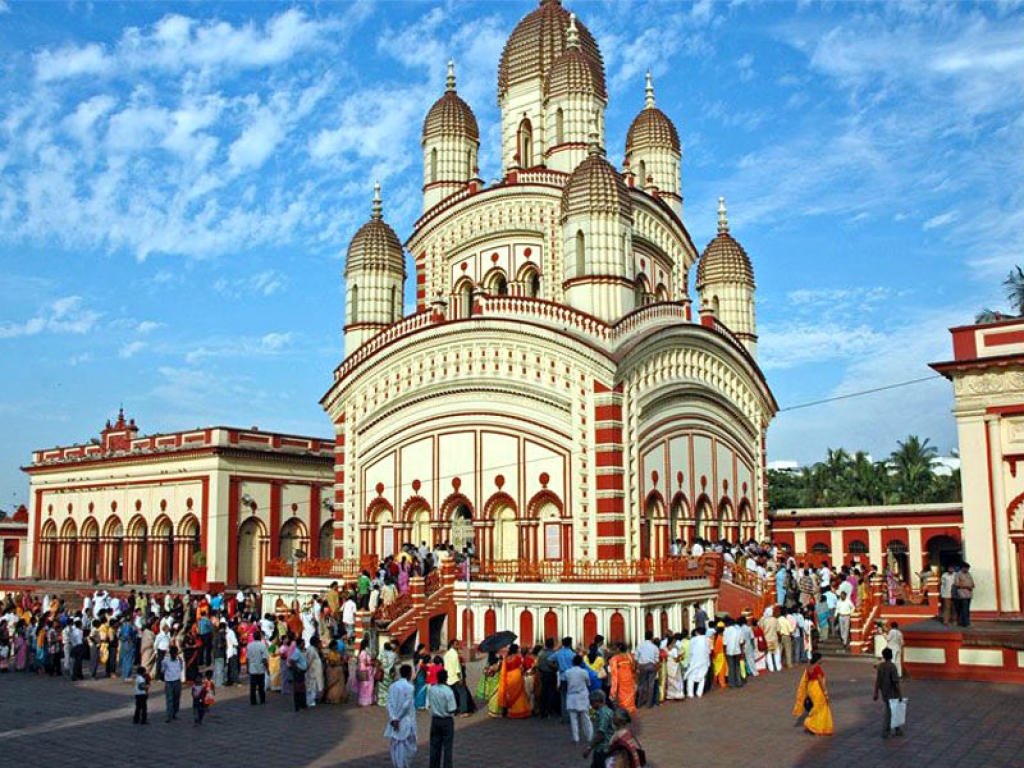
In the year 1847, the wealthy widow Rani Rasmani prepared
to go upon a long pilgrimage to the sacred city of Banaras to express her
devotions to the Divine Mother. In those days there was no railway line between
Calcutta and Banaras and it was more comfortable for rich persons to make the
journey by boat rather than by road. We are told that the convoy of Rani
Rasmani consisted of twenty four boats carrying relatives, servants, and
supplies. But the night before the pilgrimage began, the Divine Mother, in the
form of the goddess Kali, intervened. She appeared to the Rani in a dream and
said, "There is not need to go to Banaras. Install my statue in a
beautiful temple on the banks of the Ganges river and arrange for my worship
there. Then I shall manifest myself in the image and accept worship at that
place." Profoundly affected by the dream, the Rani immediately looked for
and purchased land, and promptly began construction of the temple. The large
temple complex, built between 1847 and 1855, had as its centerpiece a shrine of
the goddess Kali, but also had temples dedicated to the deities Shiva and
Radha-Krishna. A scholarly and elderly sage was chosen as the head priest and
the temple was consecrated in 1855. Within the year this priest died and his
responsibility passed to his younger brother, Ramakrishna, who over the next
thirty years would bring great fame to the Dakshineswar temple.
Ramakrishna did not serve for long as temple's head priest however. From the
first days of his service in the shrine of the goddess Kali, he was filled with
a rare form of the love of God known in Hinduism as maha-bhava. Worshipping in front of the statue of Kali,
Ramakrishna would be overcome with such ecstatic love for the deity that he
would fall to the ground and, immersed in spiritual trance, lose all
consciousness of the external world. These experiences of God-intoxication
became so frequent that he was relieved of his duties as temple priest but
allowed to continue living within the temple compound. During the next twelve
years Ramakrishna would journey ever deeper into this passionate and absolute
love of the divine. His practice was to express such intense devotion to
particular deities that they would physically manifest to him and then merge
into his being. The various forms of god and goddess such as Shiva, Kali,
Radha-Krishna, Sita-Rama, Christ and Mohammed frequently appeared to him and
his fame as an avatar, or
divine incarnation, rapidly spread throughout India. Ramakrishna died in 1886
at the age of fifty but his life, his intense spiritual practices, and the
temple of Kali where many of his ecstatic trances occurred continued to attract
pilgrims from all over India and the world. While Ramakrishna grew up and lived
within the domain of Hinduism, his experience of the divine went far beyond the
bounds of that, or any other, religion. Ramakrishna fully realized the infinite
and all-inclusive nature of the divine. He was a conduit for divinity into the
human world and the presence of that divinity may still be clearly experienced
at the Kali temple of Dakshineswar.
The
'Siva-Mahimna Stotra' composed by Pushpadanta is the most popular hymn on Siva
in North India. Sri Ramakirshna certainly knew it by heart. One day he was
reciting this hymn in one of the twelve Siva temples at Dakshineswar when he
came to the following verse:
"Asitagirisamam
syat kaijalam sindhupatre
Surataruvarasakha
lekhanipatramurvi
Likhati
yadi grihitva Sarada sarvakalam
Tadapi
tava gunanamisa param na yati."
which
means: "Oh Lord, if the blue mountian be the ink, the
ocean the ink-pot, the biggest branch of the heavenly tree be the pen, the
earth the writing leaf and taking these if Sarada, the goddess of learning,
writes for eternity, even then the limit of Your virtues will not be reached."
Reciting the aforesaid verse, Sri Ramakrishna entered into
an ecstatic mood and cried out again and again, "O Great God, how can I
express your great glory?" All came running towards that spot hearing the
cries of Thakur. Mathur Babu was in the temple at that time. Hearing the
uproar, he also came and prevented others from removing Sri Ramakrishna
forcibly from the Siva temple. Mathur had already formed a high opinion about
Sri Ramakrishna by that time. When Thakur came down to normal consciousness and
saw the crowd, he asked Mathur whether he had done anything wrong. Mathur
saluted him and said, "No, Ba Ba (father), you were reciting a hymn: I
stood here lest some one should disturb you unthinkingly." Thus Mathur
Babu protected and served Thakur in all possible ways for fourteen years like
Nandi who eternally serves Lord Siva. Truly Mathur Babu and Hriday were to Sri
Ramakrishna, what Nandi and Bhringi are to Siva. At another time, Mathur Babu
actually saw Sri Ramakrishna as Siva and Kali alternately, as Thakur was pacing
up and down.
There
are twelve most holy Sivalingas known as Jyotir-Lingas, the manifestations of
Siva in the form of emblems representing light. In the Dakshineswar temple
also, twelve temples of Siva have been constructed in a row by Rani Rasmani,
who perhaps had in mind the twelve Jyotirlingas. Sri Ramakrishna himself was a
living Jyotirlinga of Siva as he was the embodiment of divine light which arose
out of Jugi's Siva Temple of Kamarpukur. Thus it is no wonder that Thakur was
much devoted to the twelve 'Jyotir Lingas' or Siva installed at Dakshineswar.
Sri Ramakrishna could
not worship for long the twelve Sivalingas in the Dakshineswar temple which are
called Yogeswar, Jatneswar, Jatileswar, Nakuleswar, Nakeswar, Nirjareswar,
Nareswar, Nandiswar, Nageswar, Jagadiswar, Jaleswar and Yajneswar. Among these
twe1ve Sivas, Jagadiswar (literally, Lord of the world) seems to be especially
important, as the real name of the Kali at the Dakshineswar temple is 'Sri Sri
Jagadiswari Mahakali.' Sri Ramakrishna himself was Jagadiswar-Siva who actually
realised that the Jagad (world) itself is Iswara (Siva). He said "One day
while worshipping Siva I was about to place a betle- leaf on the head of the
image, when it was revealed to me that this Virat, this Universe, itself is
Siva. After that my worship of Siva through the image came to an end." But
he used to send his young disciples to the twelve Siva temples for meditation.


Kali Ma called the
"Dark Mother” on the night of Diwali (Amavasya, the darkest night), while
the rest of India worships Lakshmi, the goddess of prosperity, Eastern India,
particularly West Bengal worships Kali, the Goddess symbolizing strength.
Spectacular images of Kali, installed by the community, are worshipped and
immersed in rivers or sea. Kartik is the opening month of the year of the
Vikram era.
A 1768 publication
Shyam Sarpya Biddhi by Kashinath mentions, the celebration of Kali Puja. It is
said that Maharaja Krishnan Chandra of Nawadweep gave an order that everyone,
in his domain should worship Kali. Punishment was given to the defaulters. Thus
more than 10,000 images of Kali began to be worshipped in his domain. Before
the present Kali Puja, Ratanti Kali Puja was celebrated in ancient times.
It is believed that
the present form of the image of Kali, is due to a dream seen by Krishnanand,
author of Tantric Saar, that he should make her image after the figure, he saw
first in the morning. The image should then be worshipped. At dawn Krishnanand
sa a dark complexioned girl with left food protruding and making cow dung cakes
with her right hand. Her body was shining with white dots. While wiping off the
sweat from her forehead with left hand, the vermilion had been spread in her
parted hair. The hair was disarranged. All of a sudden, seeing an elderly, she
ejected her tongue with shame. Thus so formed the image of Kali.
Kali Puja is only a
onenight festival (darkest night of the dark fortnight of the
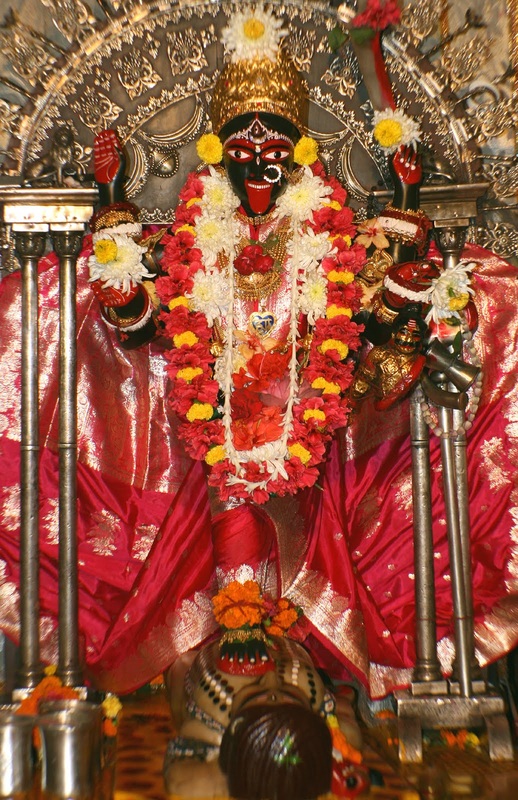
Kali Ma, called the "Dark Mother,"
is the Hindu
goddess of creation, preservation, and destruction. She is especially known in
her Destroyer aspect, squatting over her dead consort, Shiva,
devouring his entrails while her yoni sexually devours his lingam, penis. Kali,
in this aspect is said to be "The hungry earth, which devours its own
children and fattens on their corpses…" In India the experience of the
Terrible Mother has been given its most grandiose form of Kali,
which just is not simple imagery; it is the image of the Feminine, particularly
the Maternal, for in a profound way life and birth are integrally connected to
death and destruction.
Kali serves as the archetypal image of the birth-and-death Mother,
simultaneously the womb and tomb, giver of life as well as the devourer of her
children: the identical image was portrayed in a thousand ancient religions.
Current psychologists face this image with an uneasy acknowledgement of its
power. Apparently the image of the angry, punishing, castrating Father seems
less threatening than the destructive Mother--perhaps because she symbolized
the inexorable reality of death, whereas he only postulated a problematic
post-mortem judgment. Perhaps this is one reason the Roman Catholics maintain
the teaching of purgatory, to divert the final end.
The full importance of the profound
meaning of the functions of Kali as the live-giver, preserver, and destroyer
have been dismissed or destroyed over the centuries, as have been the aspects
of other manifestations of the goddess. Many western interpretations of Kali in
art and literature just depict the destructive aspect of this goddess, which
tend to portray her as fearsome and evil. In the London Museum is an image of
her which is labeled "Kali-Destroying Demon." The Encyclopedia
Britannica devotes five columns to the Christian interpretation of the Logos
and dismisses Kali's part in the creation of the world. This deity is mentioned
in a brief paragraph as the consort of Shiva, and "a goddess of
disease."
In Hinduism Kali's three functions are
assigned to the gods: Brahma, the
creator; Vishnu,
the preserver; and Shiva, the destroyer. It is noted that Vishnu, who is
thought to have brought the world out of the primal abyss, wrote the following
about Kali: "Maternal cause of all change, manifestation, and
destruction…the whole Universe rests upon Her, rises out of Her and melts into
Her. From Her crystallized the original elements and qualities which construct
the apparent world. She is both mother and grave… The gods themselves are
merely constructs out of Her maternal substance, which is both consciousness
and potential joy."
As a Mother, Kali was called
Treasure-House of Compassion (karuna),
Giver of Life to the World, the Life of all lives. Despite the popular western
belief that she is just a Goddess of destruction, she is the fount of every
kind of love, which flows into the world through women, her agents on earth.
Thus, it is said of a male worshipper of Kali, "bows down at the feet of
women," regarding them as his rightful teachers.
Some say the name Eve perhaps
originated from Kali's leva or Jiva, the primordial female principle of
manifestation; she gave birth to her "first manifested form" and
called him Idam (Adam). She also bore the same title given to Eve in the Old
Testament: Mother of All Living (Jaganmata).
Although referred to as "the
One," Kali was always a trinity Goddess: Virgin,
Mother,
and Crone.
This triad formed perhaps nine or ten millennia ago has been manifested in many
cultures: the Celts with their triple Morrigan, the Greeks with their triple
Moerae, the Norsemen with their Norms, the Romans with their Fates and triadic
Uni (Juno),
the Egyptians with their triple Mut, and
the Arabian Moon-goddess. Kali can be identified everywhere. Her trinity is
recognized in the Christian triple Godhead; some conclude this Godhead is all
male, not nothing that in the Hebrew Old Testament the word for Spirit, ruwach, was of feminine gender.
Blood sacrifice was important in the
worship of Kali as they were in the worship of the early Biblical God, the
commanded that the blood must be poured on his alters (Exodus 29:16) for the
remission of sins (Numbers 18:9), but there were differences. Jewish priests
ate the sacrificial meat themselves whereas the devotees of Kali were permitted
to eat their own offerings as in Calcutta. Kali demanded only male animals be
sacrificed; a custom dating back to the primitive belief that the male had no
part in the cycle of generation. The god Shiva, Kali's sacrificial spouse,
commanded that female animals must not be slain on the altar.
Kali was the Ocean of Blood at the
beginning of the world; she might be said to be the primordial mass from which
all life arouse; and her ultimate destruction of the universe is prefigured by
the destruction of each individual, though her karmic wheel always brought
reincarnation. After death came nothing-at-all, which Tantric
sages called the third of three states of being; to experience it was like the
experience of Dreamless Sleep. This state was also called "the Generative
Womb of All, the Beginning and End of Beings." Kali devoured Time, she
resumed her "dark formlessness," which appeared in all myths of
before-creation and after-doomsday as elemental Chaos.
The Tantric worshippers of Kali readily
acknowledged and accepted her Curse; they willing accepted her terror of death
as well as they accepted her beautiful, nurturing, maternal aspect. They knew
the coin of life has two sides, life and death; one cannot exist without the
other. Kali's sages communed with her in the grisly atmosphere of the cremation
ground, to become familiar with the images of death. Her devotee would say,
"His Goddess, his loving Mother, in time who gives him birth and loves him
in the flesh, she also destroys him in the flesh. His image of Her is
incomplete if he does not know her as his tearer and devourer."
The name Kali Ma comes from Kalma, a
hunter of tombs and eater of the dead, as she was called in Finland, also
called the Black Goddess. European "witches" worshipped her in
funeral places, for the same reasons, that the Tantric yogis and dakinis
worshipped her in cremation grounds, as Smashana-Kali, Lady of the Dead. Former
pagans adored her in cemeteries as the Black Mother Earth, where the Roman
tombstones invoked her with the phrase Mater genuit, Mother receipt-the Mother bore me, the Mother took me
back.
Sometimes Kali, the Destroyer, wore red
symbolizing the blood of the life that that she gave and took back: "as
She devours all existence, as She chews all things existing with Her fierce
teeth, therefore a mass of blood is imagined to be the apparel of the Queen of
the Gods at the final dissolution." The gypsies in their worship of Kali,
the Goddess of disease, clothed her in red, the proper color of gypsy funerals.
She is the goddess in her form as
Dakshina Kalika - one of the most popular Bengali images of the goddess. Her
guises are many, and include Bhadra (auspicious) Kali, Shmashana (cremation
ground) Kali, Guhya (secret) Kali and a host of others. It is only in the great
tantrik traditions that we find a clue to the real meaning of the gruesome
images associated with Kalika. Although Hinduism was much reviled by early
Western colonisers for its idolatry and pantheistic practices, this was a very
narrow view. Tantrik texts repeatedly speak of the Devis or goddesses as being
aspects of the one goddess. The same holds true for the male aspects. As
individual humans all reflect the macrocosm, it's fair to describe the gods and
goddesses of tantra as specialised aspects of ourselves - and, therefore, of
life itself.
Yet life has its dark and its light
sides. Death and love, in the tantrik tradition, are two sides of the same
coin. As we look to the sky, we can see the Sun and Moon as symbols of male and
female, of Shiva and Shakti. In the tantras, the Moon is often taken as a
symbol of the Devi, whether in its dark or its bright fortnight. When She
wanes, her images and her iconography become progressively more dark and
fearsome. But when She waxes, so her images brighten. When she is full, She is
Devi Tripura. Tripura is a name of the goddess meaning three cities. These
allude to her own triple nature as a maiden (Bala) as a fecund woman (Tripura)
and as a post-menstruating woman (Tripura Bhairavi).
Sir John Woodroffe (Arthur Avalon),
writing in the Garland of Letters, says Kali is the deity in her aspect as
withdrawing time into itself. "Kali is so called because She devours Kala
(Time) and then resumes Her own dark formlessness." (Garland of Letters,
page 235). Woodroffe says some have speculated that Kali was originally the
Goddess of the Vindhya Hills, conquered by the Aryans. The necklace of skulls
which makes up her image, he adds, are those of white people. Relying on the
texts themselves, gives insight into the tantrik idea of Kali. In the
Kulachudamani Tantra (KT), Lord Shiva asks questions answered by Devi, the
goddess. It is, probably, one of the oldest tantras, according to Woodroffe,
who published the Sanskrit text with an English introduction in his Tantrik
Texts series.
In eight short chapters, Devi expounds
the essence of her worship, sometimes in most beautiful imagery. But the
uncanny side of Kaula and Kali worship is dwelt on in great detail, with
references to siddhis - magical powers - including a mysterious process where
the tantrik adept leaves his body at night, apparently so he can engage in
sexual intercourse with Shaktis. Animal sacrifice also has a place in this
tantra.
The siddhis play a large part in the
worship of the uncanny goddess Kali. The main tantrik rites are called the six
acts (shatkarma) of pacifying, subjugating, paralysing, obstructing, driving
away, and death-dealing. But the KT includes others such as Parapurapraveshana,
which is the power of reviving a corpse, although according to some it means
the ability to enter another's living body; Anjana, an ointment which lets a
sadhaka see through solid walls; Khadga which gives invulnerability to swords;
Khecari, which gives the power of flying and Paduka Siddhi, magical sandals
which take you great distances, rather like seven league boots.
Certainly, the importance of having a
suitable Shakti is important, according to the instructions Devi gives to
Shiva. Devi here takes the form of Mahishamardini, more popularly known as
Durga, who destroyed the two arch-demons Shumbha and Nishumbha in an epic
battle between the goddess and the throng of demons. It was at this time,
according to legend, that Durga created Kali, emanating her out of her third
eye.
We learn more of Durga's legends and
myths from the Kalika Purana. The Devi, Mahamaya, appeared as Bhadra Kali -
identical with Mahishamardini - in order to slay the demon Mahisha. He had
fallen into a deep sleep on a mountain and had a terrible dream in which
BhadraKali cut asunder his head with her sword and drank his blood.
The demon started to worship Bhadra
Kali and when Mahamaya appeared to him again in a later age to slaughter him
again, he asked a boon of her. Devi replied that he could have his boon, and he
asked her for the favour that he would never leave the service of her feet
again. Devi replied that his boon was granted. "When you have been killed
by me in the fight, O demon Mahisha, you shall never leave my feet, there is no
doubt about it. In every place where worship of me takes place, there (will be
worship) of you; as regards your body, O Danava, it is to be worshipped and
meditated upon at the same time." (Kalakikapurana, ch.62, 107-108.)
For this reason, the image of
Mahishamardini always has her trampling the buffalo Mahisha.
When She, the goddess, is dark, She is
Devi Kalika, an equally high symbol of death and destruction. Throughout Her
different manifestations and phases, She remains the one true goddess, Shakti,
energy itself. She is symbolised by the yoni and the female cycle, which also
shows waxing and waning throughout the month. Her spouse, Shiva, is symbolised
by the Sun, by the phallus, by sperm, and as an emblem of consciousness without
attributes. According to the tantrik phraseology "Only when Shiva is
united with Shakti has Shiva power to act. Otherwise he is a corpse
(shava)."
Another black deity of the Indian
sub-continent has a close connection with Kali - Krishna. According to the
Kalivilasa Tantra, he was born from the golden goddess Gauri, who turned black
after she was hit by an arrow from the Hindu cupid, Kama.
Kali is Shakti, the great goddess,
creating the three gunas: sattvas, rajas and tamas. The three gunas in their
various permutation create all the fabric of the universe, including the five
elements, skin, blood, etc..
These principles are the substance of
she whose play (lila) is their modification. Kali is the first and foremost of
the ten aspects of the goddess. She is pure sattvas, pure spirit.
A sadhaka (male) or a sadhvika (female)
can worship the goddess -- the Devi -- in any of ten forms for the fruition of
desires. Her ten major forms are Kali, Tara, Shodasi, Bhuvaneshvari, Bhairavi,
Chinnamasta, Dhumavati, Bagala, Matangi and Kamala. These aspects are known as
the ten mahavidyas.
To a sadhaka, to know these is to know
the universe, as she is both space and time and beyond these categories. Each
form has its own dhyana (meditation), yantra (diagram), mantra (sound form) and
sadhana (actions).
Mahavidya Kali is the primordial Devi
who is the root of all the Great Knowledges (mahavidya). Worshipped by sadhakas
and sadhvikas, her outer forms are fearful. She destroys time, is time, and is
the night of eternity.
Kali, certainly in the left hand
tantrik tradition (vamachara), which is the path into Vama (woman and left)
enters, is subject to much misunderstanding. The right hand path
(dakshinachara) does not include the sexual component, while Vamachara allows
sexual intercourse as part of her worship.
According to Sir John Woodroffe, in his
introduction to the Karpuradistotra, which is a 22 verse hymn on Dakshina
Kalika, pashus - those of a base disposition, are forbidden to engage in sexual
sadhana at night. "The Pashu is still bound by the pasha (bonds) of
desire, etc., and he is, therefore, not adhikari for that which, if undertaken
by the unfit, will only make these bonds stronger." Verse 10 of the
Karpuradistotra spells out the practice. "If by night, Thy devotee
unclothed, with dishevelled hair, recites whilst meditating on Thee, thy
mantra, when with his Shakti youthful, full-breasted, and heavy-hipped such an
one makes all powers subject to him and dwells on the earth ever a seer."
Worship of Kali is for the hero (vira) or a person of a highly spiritual nature
(divya)
Kali's imagery is full of ambiguity,
and this is deliberate on the part of the tantrik adepts who worshipped her.
As an example, according to some texts,
the Kali sadhana takes place on a Tuesday, at midnight, in the cremation
ground. Here, surrounded by jackals, owls and other uncanny creatures of the
night, the sadhaka and his Shakti select a newly dead male corpse, which should
be, according to the texts, of a young man preferably a king, a hero or a
warrior. If he has recently died in battle, so much the better. Placing the
corpse face downwards, the two draw the Kaliyantra on his back, offer each
other food, wine and other good things, and then commence the act of ritual
sex. At the close of intercourse, the man offers his Shakti one of her public
hairs smeared with his semen and, if she is menstruating, blood.
Woodroffe says that the worship of Kali
in the pashu mode is totally forbidden by Shiva, quoting the influential
Niruttara Tantra as his source. "By the worship of Kali without Divyabhava
and virabhava the worshipper suffers pain at every step and goes to hell. If a
man who is of the Pashubhava worships Kali then he goes to the Raurava Hell
until the time of final dissolution."
As to the matter of a suitable Shakti
for the sexual rites of Kali, the NT suggests that when a sadhaka has already
achieved success with his own Shakti, he may then worship another woman. But
Woodroffe says this other woman is the supreme Shakti in the sadhaka's own
body.
The cremation ground is often
interpreted as the place where all desires are burnt away. Before realising
kaivalya (liberation), the sadhaka must burn away all the taboos and
conditionings which prevent this liberation.
The cremation ground (shmashana) is
also the supreme nadi or channel within the human organism - the sushumna --
The central channel of bioenergy within the spine of a human being, the royal
road of Kundalini.
There the Devi or goddess is coiled up
three and a half times at the base of the spine. When she unfolds and enters
the sushumna, the bliss of this cosmic orgasm causes the universe to disappear.
On the sadhaka within the shmashana yantra is Shakti, both entwined in close
sexual embrace. She is the human form of Kali, as he is the human form of
Shiva. Both are forever united. The Niruttara Tantra says (2, 27) "The
cremation ground is of two kinds, O Devi, the pyre and the renowned yoni. Shiva
is the phallus, Kuleshani! So Mahakala said." Questioned later by Shri Devi
in the same tantra, Shiva says that the vagina is Dakshina herself, in the form
of the three gunas, the essence of Brahma, Vishnu and Shiva. These three forms
represent the powers of creation, maintenance and destruction. They have their
Shakti counterparts.
"When she has the semen of Shiva,
she is Shiva-Shakti." (NT)
The Karpuradistotra comments on animal
sacrifice. Male creatures may only be sacrificed to Kali, else she becomes
furious. Verse 19 says that worshippers of Kali who sacrifice the flesh of
cats, camels, sheep, buffaloes, goats and men to her become accomplished. A
commentary by a Kaula, Vimalananda Svami, which Woodroffe only partially
translates, claims these animals represent the six enemies with the goat
representing lust, the buffalo anger, the cat greed, the sheep delusion, the
camel envy. Man represents pride. However, according to other sources, only a
king may perform the sacrifice of a man.
At the great temple of the Devi at
Kamakhya in Assam, there is evidence that male human sacrifice was performed in
the past. This site is renowned for Shakti worship because of a legend that
Vishnu once cut the body of Shakti into 50 pieces with his discus. These parts
represent the letters of the Sanskrit alphabet and are pithas (pedestals = sacred
sites) of Devi. The yoni of Shakti fell at this spot, making it the most sacred
of all.
Who, then, is Kali? Devi gives her own
description in the Kulachudamani: "I am Great Nature, consciousness,
bliss, the quintessence, devotedly praised. Where I am, there are no Brahma,
Hara, Shambhu or other devas, nor is there creation, maintenance or
dissolution. Where I am, there is no attachment, happiness, sadness,
liberation, goodness, faith, atheism, guru or disciple.
"When I, desiring creation, cover
myself with my Maya (The great power of Shakti to delude all created things
through Her play, ed.) and become triple and ecstatic in my wanton love play, I
am Vikarini, giving rise to the various things.
"The five elements and the 108
lingams arise, while Brahma and the other devas, the three worlds,
Bhur-Bhuvah-Svah (the three worlds) spontaneously come into manifestation.
"By mutual differences of Shiva
and Shakti, the (three) gunas originate. All things, such as Brahma and so
forth, are my parts, born from my being. Dividing and blending, the various
tantras, mantras and kulas manifest. After withdrawing the five fold universe,
I, Lalita, become of the nature of nirvana. Once more, men, great nature,
egoism, the five elements, sattvas, rajas and tamas become manifested. This
universe of parts appears and is then dissolved.
"O All-Knowing One, if I am known,
what need is there for revealed scriptures and sadhana? If I am unknown, what
use for puja and revealed text? I am the essence of creation, manifested as woman,
intoxicated with sexual desire, in order to know you as guru, you with whom I
am one. Even given this, Mahadeva, my true nature still remains secret."
The Yogini Tantra describes the goddess
as the cosmic mother (Vishvamata), dark as a thunderstorm, wearing a garland
and waistband of skulls, with dishevelled hair, completely naked (digambaram).
She has a rolling tongue, makes a
terrifying roar, three reddened eyes, and has a wide open mouth. She wears a
moon digit on her forehead, has the corpses of two boys as her earrings, and is
adorned with various gems, which are of the brightness of the Sun and the Moon.
Laughing loudly, she has two streams of
blood pouring from her mouth, while her throat is red with blood. In her four
arms she holds cleaver, head, and makes mudras dispelling fears and granting
boons. She, the supreme Nitya, is seated in reverse (viparita) intercourse with
Mahakala upon the corpse of Shiva. The whole scene is set in the cremation
ground.
Yet, as with most other tantrik symbolism,
the meaning of this cremation pyre operates on multiple levels. The pyre is
also the yoni. Sir John Woodroffe (Arthur Avalon), says Kali is the deity in
her aspect as withdrawing time into itself. "Kali is so called because She
devours Kala (Time) and then resumes Her own dark formlessness." Garland
of Letters , page 235.
There is a wealth of other material
about Kali and her different manifestions on this site. For example, the
Kulachudamani Tantra, refers to her aspect as Mahishamardini. See the Brihadnila
Tantra, which has chapters devoted to both Kali and to the goddess Tara. We
also publish here abstracts of the Kaulavalinirnaya tantra, the Niruttara
Tantra and the Rudrayamala Tantra, all of which have extensive references to
Kalika.
View Her yantra, her secret sadhana, or
see Hindu tantrik translations online
In Bengal, Diwali is
celebrated as Kali Puja, the day that the goddess Kali is worshipped. Kali is
hideously ugly and terrifying to look at - but only because she is so angry at
the wickedness in this world. Kali is the destroyer of all evil, and is
worshipped as such on Kali puja.
The story of Kali
that is told to children in Bengal on the occasion of Kali Puja is as follows:
Long long ago, the
world was overrun with evil - men had turned to wicked ways, and demons,
rakshasas and ogres thrived and prospered. The gods were helpless. They could
do nothing to control or contain the evil in the world.
In desperation they
turned to the supreme goddess Devi for help. Devi agreed to end the evil, and
took on the black and frightening form of the goddess of destruction to do so.
This form of Devi is known as Kali, which means 'black'. Devi in the form of
Kali then went on a rampage of destruction, killing and destroying all the evil
men and demons in the world.
Kali became so angry
that she could not stop, even when all the evil had been destroyed. She began
destroying the entire world in her fury. The gods asked her to stop, but she
didn't hear them. They turned to Shiv her husband for help as the only one who
could stop her. But Kali didn't hear him either. So Shiv lay down in her path -
and only when she put her foot on him did she come to her senses, and stop her
madness of destruction.
Kali is worshipped in
her destructive mode. She is terrifying to look at, black and furious, with
four hands, dripping blood and dressed in skulls. She is shown with one foot on
Shiv who lies prone in her path, and with her tongue sticking out in shock and
horror as she realises the destruction she is causing.

Comments? Email me at
shivabhakta@hotmail.com